


Courses Started
On 20 February 2010 I started the “C# Fundamentals” course . This is the first level of training, just before the “.NET Development Essentials” course, covering the .NET Framework class library, databases, SQL Server and LINQ, Web technologies, ASP.NET and AJAX, Windows Forms, WPF and Silverlight, as well as software engineering.
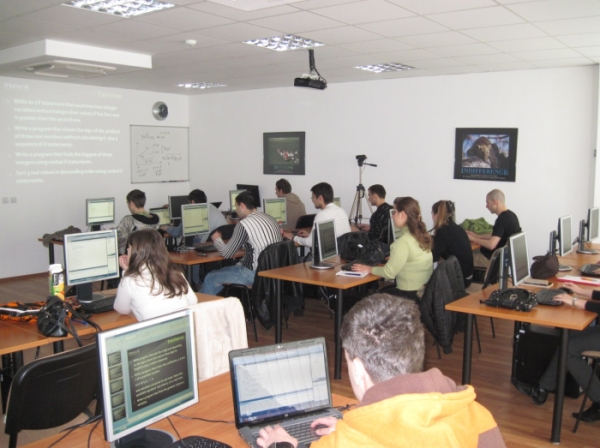
The C# Fundamentals course covers the fundamental concepts of computer programming, loops, arrays, methods, recursion, data structures, algorithms, logical thinking, problems solving and object-oriented programming. It is attended by 96 people divided into 6 groups with 16 people each. The course is split into two parts, each followed by an exam. Those who graduate the whole Telerik Academy training program will be presented with the opportunity to join the Telerik team and help Telerik to deliver exceptional software to the world. The courses themselves are aiming to provide free real-world practical training for ambitious and devoted young people.
The course content follows the free open-source book “Introduction to Programming with C#” – www.introprogramming.info.
For more information visit the “C# Fundamentals” course web site.
Most interested could also join the Telerik Academy unofficial discussions group where the lectures, exercises and solutions are actively discussed: https://softuni.bg/forum.
3 Responses to “Courses Started”
It’s such an amazing course slope
Great article! I recently wrote about a related topic at Sora 2 – would love to hear your thoughts.
Programming Basics with C# – Free Book seems useful before tackling larger projects.